Español
 العربية
 Francés
 Русский
 Português
 Italian
 Türk
Türk
 Bahasa Indonesia
 ไทย
ไทย

How to Choose Between Skid Steer Loaders and Compact Articulated Wheel Loaders?
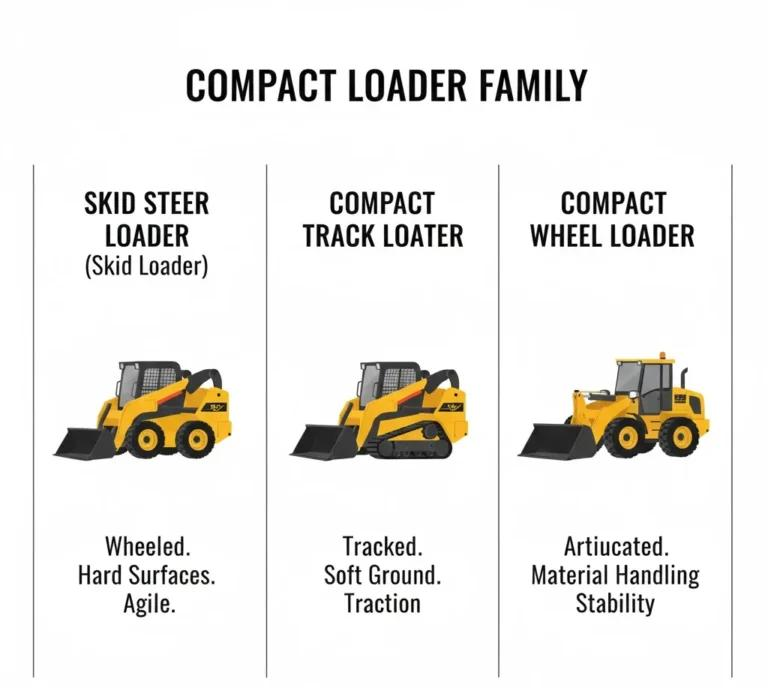
Skid steer loaders and compact articulated wheel loaders are two types of compact equipment with completely different positioning. Their core differences lie in steering mechanisms, lifting capabilities, and attachment versatility.
1.Skid steer loaders VS compact articulated wheel loaders
| Comparison Dimension | Skid Steer Loader (Skid Steering) | Compact Articulated Wheel Loader |
| Steering Mechanism | Differential steering between left and right wheels:Zero-radius 360° turns. | Articulated front and rear frames:Requires turning space, but tires do not slide/scuff. |
| Machine Dimensions | Typically <1.8m wide and low-profile; can enter factories, ship holds, and greenhouses. | Slightly longer and wider; some models feature four-wheel steering to reduce the turning radius. |
| Lifting Capacity | Rated payload is relatively lower for its weight class; lift height can be high depending on the vertical lift design. | Higher rated payload (typically 25%–40% more); superior lift height and dump clearance. |
| Travel Speed | Typically 7–10 km/h. | Typically 10–20 km/h; suitable for short-distance repositioning. |
| Attachment Versatility | High hydraulic flow supports dozens of attachments, including breakers, milling machines, augers, and sweepers. | Supports buckets, forks, grapples, and snow blades; limited support for high-flow attachments. |
| Ground Impact | Skid steering causes tire wear and can damage hard or turf surfaces (rubber tracks are gentler). | Articulated steering is ground-friendly; ideal for lawns, farms, and paved surfaces. |
| Visibility & Comfort | Lift arms on both sides restrict lateral visibility; entering/exiting requires stepping over the arms. | High-mounted seat with excellent forward visibility; side doors allow for easy entry/exit. |
| Purchase Cost | Lower | Typically 15%–30% more expensive for the same class. |
| Operating Costs | Higher fuel consumption (often runs at high idle); rapid tire wear. | More fuel-efficient with variable engine speed control; less tire wear and longer tire life. |
| Service Life | Approximately 4,000–6,000 hours. | More durable structure; can reach 8,000–10,000 hours. |
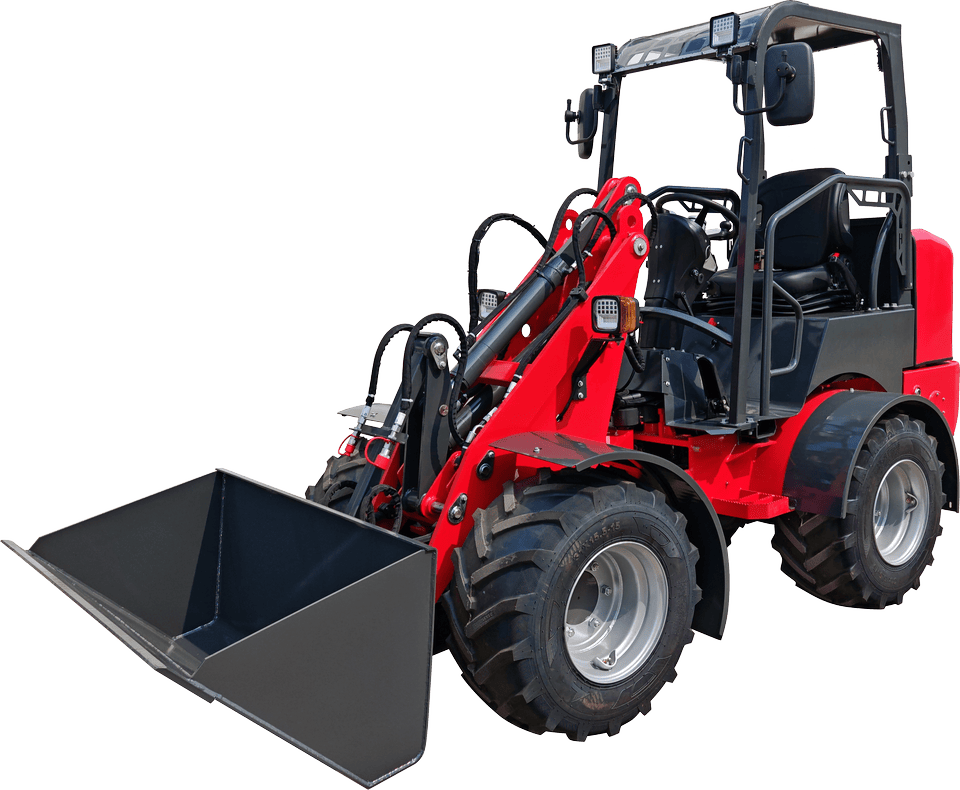
2. Choosing a Compact Articulated Wheel Loader: The "Material Handling Specialist"
Opt for a compact articulated wheel loader if:
•Your primary tasks involve scooping, transporting, and loading materials like sand, gravel, soil, feed, or wood chips, with high-volume, repetitive loading cycles daily.
•You need a larger bucket capacity and higher lift height (e.g., for loading high-sided trucks or filling hoppers/silos).
•Your site is relatively open (e.g., farmyards, sand and gravel pits, landscaping nurseries) and can accommodate wider turning radii.
•You prioritize fuel efficiency, tire longevity, and operator comfort, with plans for long-term use.
•Ground protection is critical for lawns or agricultural fields (articulated steering is gentler on turf).
•Operators prefer easy entry/exit, excellent visibility, and a machine that is easy to learn.
Typical Applications: Feeding and manure management on farms/ranches, loading at sand and gravel yards, tree transplanting and soil transport in landscaping nurseries, and transferring coal ash/waste within industrial plants.
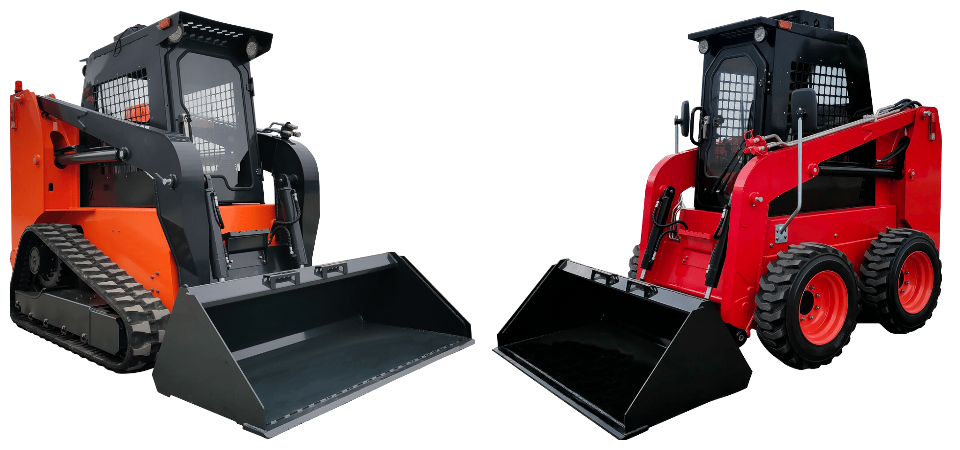
3. Choosing a Skid Steer Loader: The "Urban Combat All-Rounder"
Opt for a skid steer loader if:
•You operate in extremely tight spaces (e.g., warehouses, greenhouses, municipal alleys, indoor demolition sites, ship holds) and require zero-radius turning.
•You need to change attachments frequently. If you're breaking concrete today, sweeping tomorrow, and drilling/trenching/forking the next day, true multi-functionality is a must.
•You have height restrictions (e.g., basements, low doorways), where its low-profile design offers a distinct advantage.
•You are on a tight budget and want to invest in a versatile, multi-purpose machine at a lower upfront cost.
•You primarily work on hard surfaces (concrete/asphalt) where tire marks aren't a major concern (or you opt for a rubber track version).
Typical Applications: Municipal maintenance, indoor demolition and renovation, landscaping (via attachments), and operating in ranch/farmyard corridors, as well as road milling and sweeping.
4. Quick Decision Checklist
•Tight spaces + Multiple attachments + Budget-sensitive → Skid Steer Loader
•Heavy-duty loading + High dump clearance + Fuel-efficient & durable → Compact Articulated Wheel Loader
What if you need a bit of both?
•If attachment versatility outweighs sheer loading volume, choose a skid steer.
•If high-volume loading outweighs the need for attachment changes, choose an articulated wheel loader.